Monday, March 30, 2015

Why Do Monks Make Rock Gardens?

I sat at the end of a ledge after a long line of tourists to view for a moment one of the most famous zen gardens in the world. Famous in the sense that it’s the first image you get when you Google “zen rock gardens.” I knew that these gardens were meant to reflect nature, or some kind of truth of it, and that the inspiration for them came through some kind of intense bout of mediation, or that the mediation would come after, or that only the monk in charge could really create them. But I didn’t know why, and none of the tourists seemed to know either. Okay, don’t get me wrong, it was beautiful. Some guy 560 years ago crafted what I’m looking at now, my feet dangling over a ledge, my brain soaking up the sounds of at least 5 different languages being spoken around me trying to figure out if its beauty or power or nature or man or just a fun day in Kyoto. And I gotta say, that’s pretty cool to think about, all those possibilities existing at once.
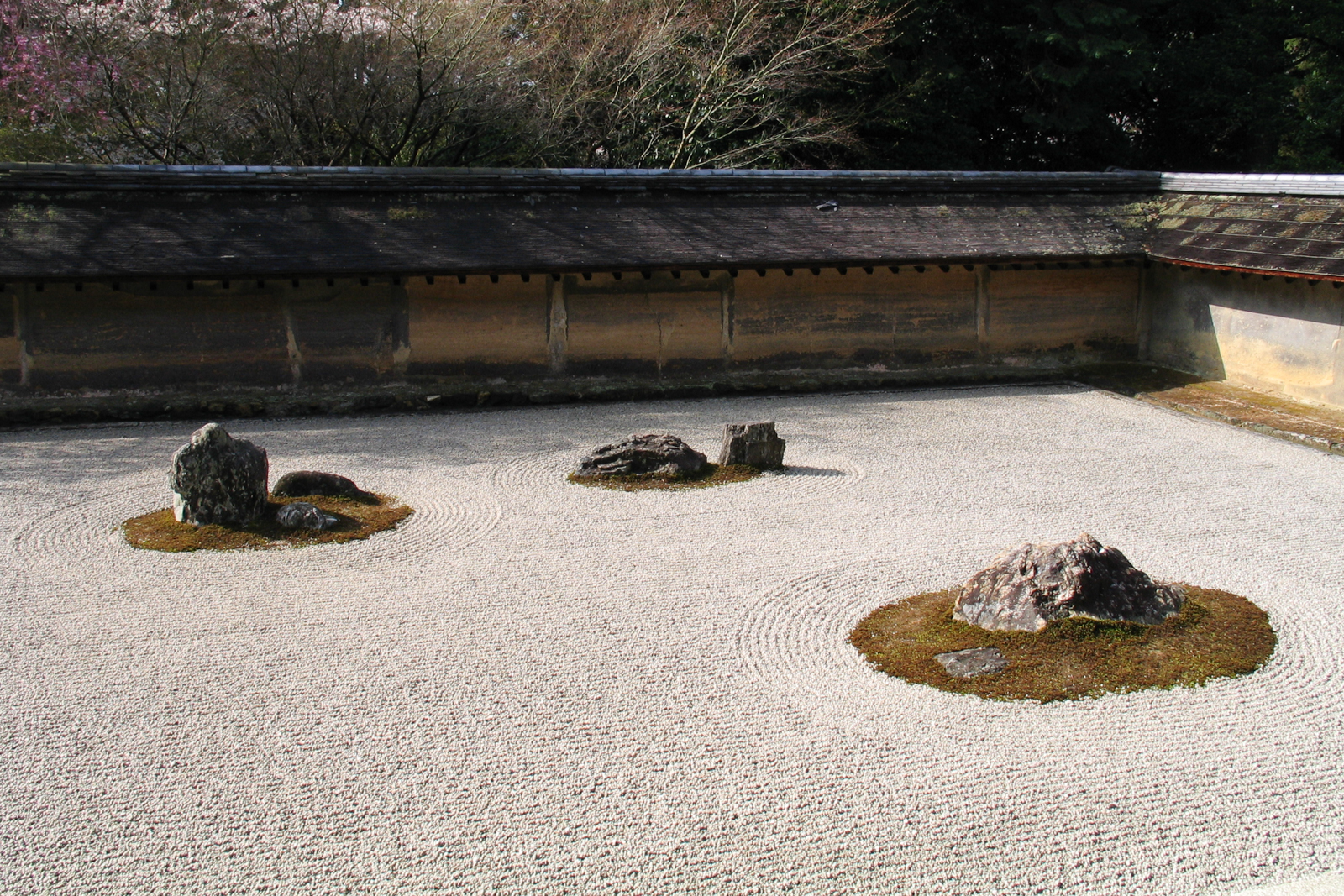

            But it doesn’t really satisfy the itch. If I’m honest, this was never about rock gardens. I dove into the internet to find an answer anyway, and rolled around in ideas of the “essence” of nature. It’s not hard to see that as much as the raked gravel represents ripples in water, the boulders mountains, and the bonsais (well you get the idea), as much as these things represent other things, they are not those things. Raked gravel is not ripples of water. It could be the essence, but perhaps it’s not. I’m not sure it is, but maybe I haven’t done the right amount of mediation to reach epiphany. How many times could you go around in that circle and not get frustrated? And then I went back to the question: why do monks make rock gardens? Why do I write stories?
            It’s not exactly the same question, but it is. It is the same. “They were intended to imitate the intimate essence of nature, not its actual appearance, and to serve an aid to meditation about the true meaning of life.” (Sorry I took that from one of the many different Wikipedia pages I visited, but it’s a good quote.) Does that not sound like it’s describing a novel, if not also the act of writing? Even if it doesn’t end in something so monumental as the meaning of life, it’s still intimate, grappling at the metaphor of a ripple of water and how it could drown Virginia Woolf or give birth to land walking creatures, or tower as a tsunami of fear. Perhaps rock gardens can do that, but maybe only for monks, the ones that daily rake its gravel into waves. And I don’t know where writers stand in that; my metaphor ran on too long.
            But that really is my point. We write stories so that no matter how many metaphors flop and flutter we get closer to something that matters. We meditate and dabble in prose poems and read a lot and write blogs hoping that something will shine, make us good, earn us a spot on Goodreads. (We write lots of lists with three items in them because it sounds nice and we don’t even realize we’re doing it as often as we are, but that’s what practice is for.) And you find that book, maybe just one, maybe hundreds of books, that resonate with you so deeply that you become the next monk in the line of monks that care for and create. And it makes you think: in 560 years, who’s going to be reading you? I kind of think that’s why monks make rock gardens.

*Up Next on Gaijin Kid – Goodbyes
**Below is a prose poem I wrote awhile ago on these same ideas (though I hadn’t exactly realized them yet).

The Art of Pretending to Meditate

I push into the earth like I’ve been told. My knees almost touch the floor, and as much as my back stretches upward into perfect posture, I am still rooted downward, being pulled by moisture and nutrients and heavy soil. But the tips of my toes are crushed by my weight, and sitting too long will make them hurt more than it will make them grow and lengthen and penetrate base truths, like sprouts in reverse. Right now I’m thinking about how to describe this position, how to write about the feelings that pass through me: glimpses of sun from the balcony door, wafts of sweetened oxygen, earth, tree roots, rooted. But the door is shaded and closed, I breathe mostly nitrogen, I am not yet good enough. I’m distracted by thoughts of other writers and other words, and I have to remind myself again not to think. For the moment I have switched off the sounds from the computer, the TV, the playlists meant to calm me into deep focus, so that I can hear nothing but my own breathing. But this does not silence my motivations. Now I’m imagining the opening passage of a novel I once read that laps against me again now like waves or other ocean imagery. Its metaphors are poignant, its sentences moving, its feeling a magical release of pent up pure, simple storytelling and, yet, more. Against my dreams this is nothing, and I breathe in, breathe out, confidence, doubt, desire, doubt, counting each new kiss of the shoreline. I whisper it away in carbon. To acknowledge these rogue thoughts I bring my hands up into a prayer against my sternum. I have been told this is to remind me to impel my body into alignment, as if the gods I am trying to become are never malformed by the weight of their flesh. I can feel, intimately, in this quiet and ready stance, the folds of my skin, the puckers of body between my shoulders and my breasts, my heavy branches subduing the roots beneath. With the drop of my hands into a dictated relax I am to blur the distinction between my body and the air around me. My hands are no just extensions, my mind pays no attention; there is no difference between ego and the world. My thoughts scatter again. But, still, this does not scatter my edges. They are always there, changed only in pliancy over time. Or perhaps, I am becoming the wrong god; I have not been practicing correctly. This is the way it is supposed to be: A creeping total awareness will overcome you in a matter of moments like the crossing of slits of sunlight along the floor of an empty room, and you will not be able to resist the way it feels to grow into the earth and the silence as if you are the room and the warmth and the space and the slits of sunlight and the roots of a tree and the waves of an ocean and the fluid of your thoughts as they each recess inward into nothing. You are nothing.


Wednesday, March 18, 2015

We're Not in Tokyo Anymore

“There’s, like, way less trains.” – Me, looking at a subway system that’s not Tokyo’s.

            I recently returned from a trip to Kyoto, Japan, where I took no less than 342 pictures and hit most tourist spots in less than three days. I was tired. I had been a tourist for too long. But Kyoto, in all its tourist glory, was still somehow peaceful, somehow beautiful in the still dead, still cold beginnings of spring. (To be fair, though, I did take an uncomfortable amount of pictures of trees.)
            The trip started out simple enough: three hours on the shinkansen, checking into the predominately foreigner hotel (what are all these languages in one elevator? Cool as **** that’s what), and then meandering off into Kyoto Gyoen Park. The park, or old imperial palace, or national gardens, there’s lots of names for it, was much larger than the Tokyo version and had some teaser plum blossoms that I thought were cherry blossoms at first. Overall it was a happy start to the trip. As immense as this park was, as long the stretches of gravel, as tall the walls, it was quiet and beautiful and you couldn’t help but smile. I was out of the city, I was starting a new venture, if even just a small one. And one guy certainly agreed with me: 


           The next two days I swear I saw every temple and shrine in Japan. I didn’t pray at too many of them, though, because I was informed that if I was too greedy the separate deities could start fighting and ain’t nobody got time for that. But really, I didn’t want to push my luck, I do want those wishes to come true. So we moved through, took pictures, and hoped for the best.
            What’s most interesting about Kyoto is that one moment you could be crawling over other tourists, like at the golden temple (Kinkakuji), and then the next you could be slipping into a place of prayer, an intricate garden, a back alley suburban-esque street and find yourself completely alone in the silence of peaceful life: the only signs of Kyoto’s foreign attraction the occasional rickshaw with kimonoed tourists. Over all the souvenir shops, all the udon noodles (delicious if even impossible to eat with hashi), all the freaking people, Kyoto is nice. I tend to forget how busy and large Tokyo really is until I compare it to another city in another part of Japan—or even another part of the world. Parts of Kyoto could be the Maple Grove of Japan, no part of Tokyo ever could.
            Turns out there are still a lot of things to see and a lot more pictures to be taken. But for now, enjoy a select few of my favorite places and things, and wait patiently for a more informed blog next time.


**Up Next on Gaijin Kid: Why Zen Monks Make Rock Gardens. 

Thursday, March 12, 2015

Studio Ghibli Museum Mitaka, or Look at all my many Friends, so many.


            Walking into the Ghibli Museum is as magical as you’d think it would be. Totoro is there to greet you and ask for tickets, which you have to purchase a month in advance for fear of it being sold out, and the doors open into a wonderful labyrinth of childhood. Not unlike most parts of Japan, it is full of people. You watch your feet so you don’t step on an actual child while you’re lost in memories of your own growing up years. You step back, a bit, from the window in front of you so that they can reach it with their small frames, but you look through it, too, with just as much wonder. Every wall is filled with sketches, every secret cupboard has intricate displays, simple machines, showing you the magic of animation. And magic really is the only word for it. I feel, moving from room to room in a sort of daze and wanderlust, as if I’ve fallen down a Totoro hole (no Rabbit holes here) straight into Hayao Miyazaki’s mind. This is his labyrinth. This is his imagination. This is an ideal Japan, a perfect balanced blend of nature, spirits, and humanity, and of course the technology that makes it all happen.
            There are winding staircases, tiny secret doors for tiny people, soot spirits crowded into windows, stained glass depictions of Mononoke, and. an. actual. cat. bus—if you’re young enough to board. And that’s just the inside (where you can’t take pictures, and it’s packed like a rush hour train—can you really blame all of these people though? This place is great). Outside you feel like you’ve left the city behind. You’re snuggled between the museum and a park, which has all been placed at the end of a cute street lined with Cherry Blossoms (if it were warm enough yet for them to bloom). You go up another winding staircase and you find Laputa, and it feels like you’re there. Patches of green cover and destroy any sense of the machine beneath, any sense of the city sprawling and sprawling and sprawling across Japan. I’m standing on the roof of a castle of childhood, feel like floating into the sky.
            And then it becomes real. Trying to navigate the gift shop isn’t so hard after seven months in an over populated city, but it’s not easy. I stack up on almost whatever I see, I’ve saved souvenir money for this, I look at all of it twice, I debate over buying a few soundtracks, a copy of my favorite move in Japanese—5000 ¥, unfortunately I’ll pass—and in the end I leave satisfied and happy.
            I wish I could write for you, and for myself again, the experience I had at this museum—even if it was just a museum—but it’s far better to either see it yourself or drown yourself instead in a Ghibli marathon. So instead I’ll list my favorite movies in some kind of an order of recommendation and hope I’ve teased you enough to make you jump on a plane to Japan.


            06. Whisper of the Heart – This movie is sweet and touching and has a rendition of John Denver’s “Take Me Home, Country Roads” which is, like, uber damn popular in Japan. It opens to a familiar scene, now so close to my heart, of Tokyo, Japan. (There is even a Family Mart ♥). It seems a little different, though, for what we Americans are probably used to Ghibli being. It’s less...spiritual, but still magical. It tells the story of a budding romance between a girl and this kid who checks out all of the same books she does at the library—and crafts violins. It’s just, cute. Watch it while cuddled up with a friend or a Totoro and a cup of hot chocolate.
            05. Howl’s Moving Castle – This movie was higher on the list until I saw some of the other ones, sorry Howl, because it has the most amazing characters. Sophie is smart and sarcastic and knows what’s up when it comes to moody teenage (dare I say it Host-like?) guys. And the fire, Calcifer, adorable. It’s darker and scarier than other Ghibli movies, save perhaps a scene in Spirited Away, and so that moves it down the list for me. Overall I get a complicated vibe, and maybe I’m a little bitter about the relationship between Howl and Sophie. But still, a very visually appealing movie.
            04. Spirited Away – This movie is better the second time around, and features of very interesting depictions of Japanese culture. It tells the story of a young girl who is, haha, spirited away, to grown and learn a few lessons. It is an interesting, light hearted, and unique commentary on the qualities of humans that make them selfish but also incredibly heroic. This is the movie you watch when you want some Japanese infused into your life.
            03. Laputa, Castle in the Sky – Now, this movie I didn’t watch until I was planning on visiting the museum and had to stock up on my Ghibli knowledge, but I’m very glad that I did watch it. The movie starts out strangely to me, it feels far less Japanese than others I grew up with (ala Spirited Away, Totoro). However, it is absolutely beautiful. I cried for the first time at a Ghibli movie at this movie. Those robots, god they just get straight to your heart. Hinged on the story of two orphan kids searching for answers and truths, Laputa draws out the beauty of our world and challenges modernity. I believe Miyazaki had strong feelings about urban sprawl and a love for nature, and this movie beautifully depicts those challenges and ideas. Much recommended to watch with an open mind and an open heart.
            02. Princess Mononoke – I consider this movie to be the best Ghibli movie. It’s not number one for reasons you’ll soon see, but it is definitely the most emotionally and intellectually complicated story of the lot. Perhaps it seems easy to understand: city bad, forest good, but this movie tackles issues of environmentalism such a high level of artistry and craft it’s really difficult to not like this movie…even if you’re a fan of destroying the earth. Not only that the music is mind numbingly beautiful. Recommend, recommend, in any mood, at any time, recommend.
            01. My Neighbor Totoro – Arguably the most popular/famous of all Ghibli movies, Totoro will forever live in the warmest part of my heart. This movie mixes the Japanese culture of Spirited Away, the modernity and simplicity of Whisper of the Heart, and the social commentary of Princess Mononoke into one perfect childhood adventure. It is reminiscent, perhaps, of Alice in Wonderland, but much less worrisome and psychologically intense. Totoro is a soft spirit: kawaii like a neko (cat), strong like a kuma (bear), loving like Mother Nature herself. Two young girls going through immense changes in lifestyle and family meet him when they start their new adventure, and he protects as much as he challenges them to grow (like treeeeesss). I can’t say how much I love Totoro, it is one of the greats, and there is a reason it is used as the face of Studio Ghibli. So watch it, please, be innocent again.


** Up Next on Gaijin Kid: Kyoto!

Wednesday, March 4, 2015

Watashi wa Genki

私は元気


            I bought the inevitable plane ticket home just the other day, and ever since I’ve been nostalgic for things I’ve yet to experience, or am currently experiencing, or are right on the outer surface of my memory. Yes, already, and yes, too soon, and yes, not soon enough. This is not my last post, I’ve got several big events coming soon, but this is one of the ones winding down. And as much as it’s difficult to face an ending, I’m very proud to look back at all I’ve learned and experienced along the way.
            Still though, there’s nothing like home. I’m a month away from a plate of Mexican food (even Minnesotan Mexican food is better than no Mexican food), from a drink at the local bar—any of the several I miss right now, from cuddling with my cat and saying hello once again to the dog, oh and my parents of course, my sisters, my friends. I’ll be home soon enough, I’ll slide into a job somewhere close, and sit and wait for hopefully not that long for Yuusan to follow suit. And as that month draws nearer, as I start to almost salivate over the images, I’m reminded of what I have to now leave behind. It’s a case of wanting to go home but having to realize that that means leaving first.  
            Here in Japan I have Totoro around every single corner (I mean actually every shopping town has got a Ghibli store). I’m allowed to freak out over the cuteness of cats, even if it’s just a normal cat. People are friendly, perhaps because they want to practice their English but I’ll take it. And I can ride the train anywhere I want for maybe two dollars. In fact the Yen is weak so everything is cheaper than I think it is. In Japan there is katsudon, curry, omurice, curry, ramen, curry, Chinese Chinese food, and curry.  There is also curry (and naan, omfg). Here in Japan I have gained confidence and calmness. I have fallen in love with Tokyo.
            It is now possible that I can love both Tokyo and Freeborn. I am at home among the sky tall skyline, and longing for home where the stars do actually shine at night. The city is safe and beautiful, the country is safe and beautiful. The weather here is warm and mild, the weather back home is cold and brittle and fresh. I want to be here, I want to be there. And overall I’m a little emotional.
            I watched My Neighbor Totoro as a kid, loving it, never knowing I would be here some day, never expecting my life to turn out the way it did. And yet here I am, still loving it, and loving so much more. I’ll be back to you soon, Minnesota, but I have to stay this one month left. Coming up, the Ghibli Museum and a trip to Kyoto, cherry blossom season, and likely many many more rice bowls. And feelings. There’s always feelings. 

Sunday, February 22, 2015

Find the Face

I may have started off my weekend with a visit to Akiba Electricity Town, the otaku mecca of Japan, brimming with lights and video game scores and  maid cafes—a whole other world, so to speak—but what ended up inspiring and energizing me was instead a quiet visit to a bonsai museum. There I walked through a peaceful and traditional Japanese house in my socks, viewed hundreds of years old trees in stunning art installations, sipped green tea, walked through paths of bonsai after bonsai, and watched koi through plum blossom branches. Yes, I’ve been in Japan for six months already—but this is the most Japanese thing I’ve done since I walked through Tokyo with a massive suitcase and stumbled through crowds in the station.
            And it was beautiful.


           That, folks, is a bonsai that is something like four hundred years old. It is being sold for no less than one million dollars—I checked, and yes, the tour guide meant dollars not yen. The second one is not quite so old or expensive, but it's just as gorgeous. Parts of the tree are already dead, the white parts, and still it perseveres. (So it’s cliché, so what). The new grows with and around the dead, and only then does it become a tree so valuable. What is most remarkable about bonsais is that they take time. No amount of artistry or genius or college degrees change that; these trees are beyond us. It’ll be three years before we can remove the wiring from our own bonsais and see the new tree beneath—if we can manage to have them live that long.
            But I’m hopeful, because after the museum tour, Yuu and I sat down to learn hands on about bonsais and started our very own potential million dollar trees. (Yeah, great-great-grandkids, you can thank me with a memorial or a scholarship fund for public school students). And the experience, a little frustrating, a little confusing, and a little messy, was incredibly invigorating.

Jillian's bonsai before. 

Yuu's bonsai before.  

            It started with the basics of course. (After we struggled with how to write my name in roman letters—I should start going by J or Jin). You have to find the face of your bonsai, which is a little bit like struggling to write its name in foreign letters. You look for its character; find the movement in its branches and trunk that are beautiful and interesting. Then after you’ve found its character, you create a balance throughout the branches. Branches shoot off in twos, and then twos, and twos again. You have to cut away the odd ones; pull out shoots that are too tall, too short; make tables of branches, that will grow and grow and be full. And then, you find elegance and settle into your bonsai with the craft and help of your sensei (ours was one of eight apprentices of Kunio Kobayashi—who I glimpsed giving personal tours to what looked like very important Japanese men, religious leaders is Yuu’s theory).

What all of that means, really, is when you’re starting out with a new, fresh bonsai, you’re getting to know it just like anyone else. And, just like in people, you want to look into its face and uncover the truth of it. Or, if you’re not looking for truth, the beauty and artistry of it will do. And I guess I like that. So below are our face-full bonsai trees after our lesson, which will wait still years until we craft them again, and several other beautiful examples from the museum and the artists there. 
Jillian's bonsai after.

Yuu's bonsai after.

My favorite. It's just, so pleasant to look at. 


Tuesday, January 20, 2015

In a Station of the Metro

Everyone knows what a haiku is, or at least they think they do. It’s got something to do with syllables, maybe it’s supposed to be in Japanese, but mostly many of us have never read a haiku that wasn’t something silly:

            One shark said to the
other when eating a clown
fish: this tastes funny.

I mean, what on earth is that!? Courtesy of “WikiHow: How to Write a Haiku Poem.” But since I’ve been in Japan and I’ve taken the time to dive into Japanese poetry—mostly because why wouldn’t I make an excuse to read poetry instead of working a day job—I’ve come to understand the form and see it’s real beauty. A haiku is not just five syllables followed by seven and followed by five. In fact, like a sonnet or any other form poetry, the form can be broken a million times over and still be a haiku. What a haiku is instead is a poem that intensifies a kind of expression, which in the simplest and most direct way reaches a new association between images. Haikus are very often about nature, or the human impression of nature, and connect two things with a sense of wonder. Reading a good haiku is like having a mini epiphany. It is like stumbling across the best line of a novel, or the most enchanting moment of a song.
Traditionally the form included rules about the inclusion of seasonal clues and hints, a word that would specify the time of year, and pauses at the end of the first or second line. The form was not simply five, seven, five in syllables but more specific to the Japanese language and verse—which we all know can’t be the same as English and English poetic devices. (Actually the sound units counted can get quite complicated. If you’re interested in researching them more, please turn to the internet. I’m not an expert of analysis, just a lover of reading poetry). And on top of all of that it was written in the present tense, as if suddenly illuminated is the world for this moment if you can catch it.

An old pond!
A frog jumps in—
the sound of water.

That haiku, translated from the original Japanese, was written by the first poet to write in the haiku form, Matsuo Basho. So what does all this mean or matter? It just means and matters whatever you want it to, and for me it means giving a little more time to haikus and matters in the way we look for truth in the world. Poetry in general does this, but what I think that haikus do that is special is that they require a cutting away of all the extra crap. Haikus are read in one breath, haikus are moments of enlightenment put into 17 nano-moments, and carved out of words that have to do double or triple duty. I would like to see every poet write a good haiku, to prove to themselves that they can write a successful poem. And if you’re a poet, you’ll understand me. I’ve yet to write a good one. So with that said, I’m not sure I have more to say anyway, here are a few of my favorite haikus.

In a Station of the Metro – Ezra Pound
            The apparition of these faces in the crowd;
            Petals on a wet, black bough.
           
            Masaoka Shiki
            Consider me
            As one who loved poetry
            And persimmons.

            Yosa Buson
            Before the white chrysanthemum
            the scissors hesitate--
            a moment.

*This just in: Japanese kids learn Matsuo Basho’s poem “An old pond!” in school and remember it because everyone should be able to recite at least one poem by heart (so haikus are short, still great). Also I have it from the bilingual opinion of Yuu Kurashima that it’s just not the same when it’s not in Japanese…so there’s that. (And every single website has a different translation of it and I picked what I thought was the best one, but I suppose that's quite subjective.)


**Up Next on Gaijin Kid: Yoyogi Park Short Fiction by me. 

Wednesday, January 7, 2015

For the Time Being

“How do you search for lost time, anyway? It’s an interesting question, so I texted it to old Jiko, which is what I always do when I have a philosophical dilemma. And then I had to wait for a really, really long time, but finally my keitai gave a little ping that tells me she’s texted me back. And what she wrote was this:

在る時や
言の葉もちり
おち葉かな

which means something like this:

For the time being,
Words scatter…
Are they fallen leaves?

I’m not very good at poetry, but when I read old Jiko’s poem, I saw an image in my mind of this big old ginkgo tree on the grounds of the temple. The leaves are shaped like little green fans, and in the autumn they turn bright yellow and fall off and cover the ground, painting everything pure golden. And it occurred to me that the big old tree is a time being, and Jiko is a time being, too, and I could imagine myself searching for lost time under the tree, sifting through the fallen leaves that are her scattered golden words.” – From A Tale for the Time Being by Ruth Ozeki

            I’m sitting curled up with coffee and wondering how I can bring back a blog last updated sometime mid October and all I can think to do is pull towards me Ruth Ozeki’s novel, flip to the first few pages, and write out a passage. And really, this doesn’t surprise me, because I all do these days is read and practice sitting Zazen (literally translated into “seated meditation”) and this particular novel is a gold mine of beautiful thoughts. And, even though this is winter, I can still remember the ginkgo trees in the autumn and the absolutely spiritual level of gold their leaves turned and how I saw it all every day from my balcony. So it doesn’t exactly matter that it’s been awhile since I’ve updated, because I can close my eyes and think I’m still in October. *Photos by Moeko ^^


            October is crazy, and it’s still pretty warm outside so I don’t ever know if I should wear a sweater and jeans or if I’ll be cold or too hot or none of the above but regardless I still don’t really fit in here. And then time passes and its January 2015. I spent my first holiday season away from home. For the first time I did not take a family photo at Thanksgiving by Sherry’s fireplace, and I did not watch my father out of the corner of my eye for balls of wrapping paper to be tossed while the cousins opened colorful toys…or perfume, I guess we’re old enough for that now. And then I spent New Year’s in the middle of Tokyo. I listen to Avril Lavigne’s Hello Kitty for the first time, and after a few play backs I start to hear instead Sk8er Boi so I feel like its ninth grade now.

            I think about old Jiko in the novel, who is a monk, or a nun, who talks a lot about moments of time and I start to realize this is what happens when you randomly decide to devote yourself to Zazen. It makes you kooky and weird about time—which I think comes off as lazy—and you write novels about time traveling Victorian lit professors instead of  novels that are going to get published…or instead of anything at all. But I guess that’s just a side effect, because what Zazen does actually accomplish is a wholly real sense of self made up of all the ninth grades, all the Thanksgiving family photos, all the Octobers and the moment that is now; how quickly that moment slips past, how if I reach out to grasp it I let go of the juzu beads and lose count of my breathing.

            And maybe none of that makes sense, because I think I have to think on it a little longer to really understand it myself, but what I’m getting at is starting a new year really isn’t possible without thinking of the old one. Moving into a new year in a faraway place, especially when you are wrapped up in the philosophies of Buddhism at the current moment, made me hyper aware of the past and the familiar and of everyone and thing I miss back home. But I’m not sad, not like I was sad when I wrote my first post, because I have a new year ahead of me. In my short time in Japan, and my even shorter time thinking about these time sensitive subjects, my experience with Zazen has been wonderfully eye-opening and calming. So if you’re looking for a New Year’s resolution still, and one unlike any other, I give you the basic instructions of how to practice Zazen. Try it once, and maybe you’ll better understand my ramblings.

*Taken from Ozeki’s novel & Wikihow (Really, it’s that simple).

            Sit, either on the floor with a zafu (cushion) or on a chair if you need extra back support, and keep good posture. If you’re sitting on the floor, cross your legs. “The Burmese Position: This is the simplest position in which the legs are crossed with both knees resting flat on the floor. One ankle is in front of the other, not over. The Half Lotus Position (Hankafuza). This is done by placing the left foot onto the right thigh and tucking the right leg under your left thigh.The Full Lotus Position (Kekkafuza). This is by far the most stable of all positions. It is done by placing each foot onto the opposite thigh. This might be slightly painful at first but keep trying and the muscles in your legs will loosen up.” Now place your hands in your lap and stack them so that the back of your left hand is on the balm of your right hand and your thumbs meet on top to make a relaxed circle.

            Then relax and focus on your breathing. There are several kinds of Zazen, some that require you to focus on a particular idea of Buddhism and others that are simpler. You can try Shikantaza which is literally translated into “nothing but precisely sitting.” Count your breathing, inhale…exhale…one, inhale…exhale…two, up to ten. When you’ve reached ten, start over. If a rogue thought interrupts you, acknowledge it, and return to “nothing but precisely sitting.” And that’s that, that’s Zazen.

            “Jiko also says that to do zazen is to enter time completely. I really like that. Here’s what old Zen Master Dogen has to say about it:

Think not thinking.
How do you think not-thinking?
Nonthinking. This is the essential art of zazen.


I guess it doesn't make a whole lot of sense unless you just sit down and do it. I’m not saying you have to. I’m just telling you what I think.” –A Tale for the Time Being.

**Up Next on Gaijin Kid: Haikus