


I sat at the end of a ledge after a long line of tourists to
view for a moment one of the most famous zen gardens in the world. Famous in
the sense that it’s the first image you get when you Google “zen rock gardens.”
I knew that these gardens were meant to reflect nature, or some kind of truth
of it, and that the inspiration for them came through some kind of intense bout
of mediation, or that the mediation would come after, or that only the monk in
charge could really create them. But I didn’t know why, and none of the
tourists seemed to know either. Okay, don’t get me wrong, it was beautiful.
Some guy 560 years ago crafted what I’m looking at now, my feet dangling over a
ledge, my brain soaking up the sounds of at least 5 different languages being
spoken around me trying to figure out if its beauty or power or nature or man
or just a fun day in Kyoto. And I gotta say, that’s pretty cool to think about,
all those possibilities existing at once.
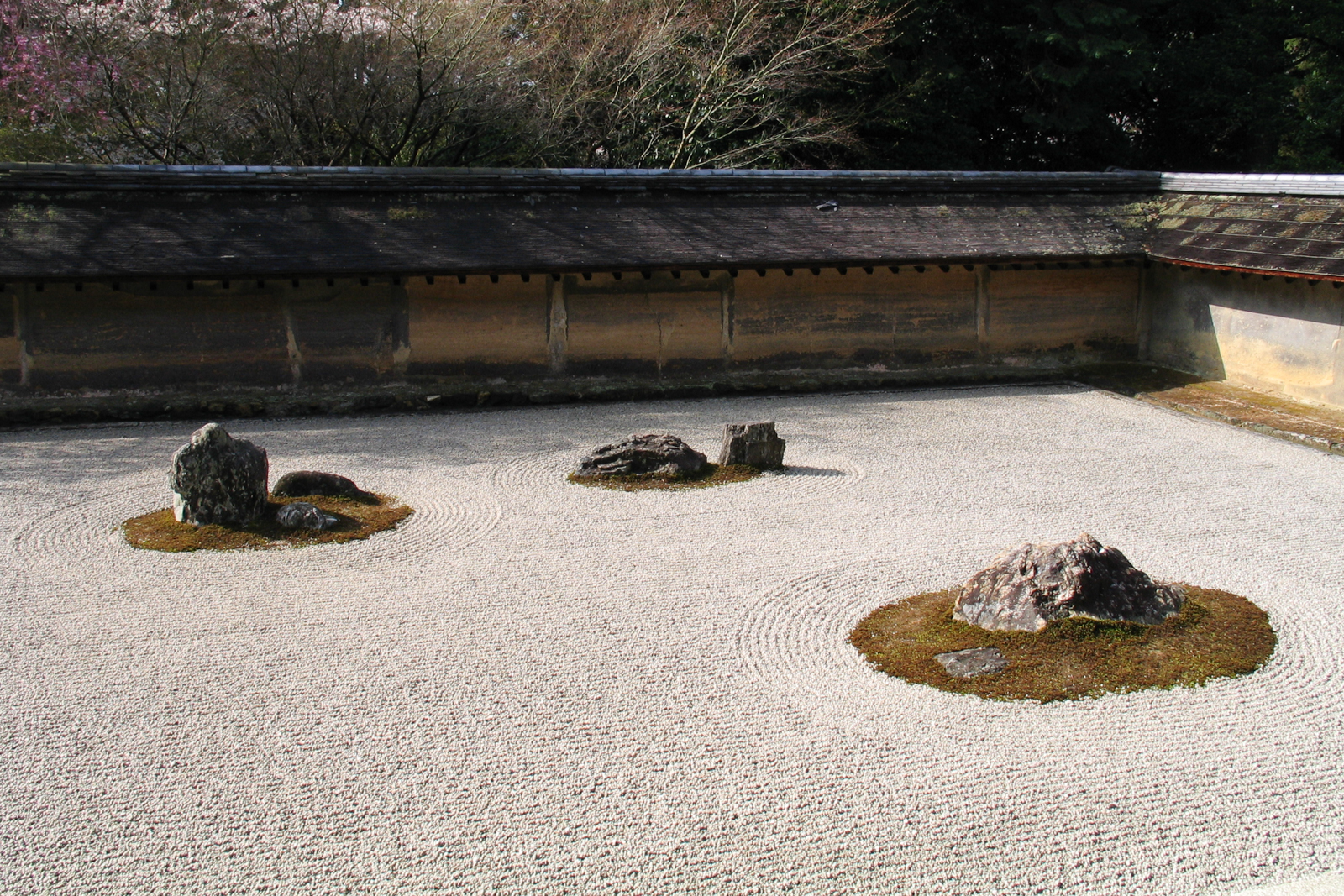
But it
doesn’t really satisfy the itch. If I’m honest, this was never about rock
gardens. I dove into the internet to find an answer anyway, and rolled around
in ideas of the “essence” of nature. It’s not hard to see that as much as the raked
gravel represents ripples in water, the boulders mountains, and the bonsais
(well you get the idea), as much as these things represent other things, they
are not those things. Raked gravel is not ripples of water. It could be the
essence, but perhaps it’s not. I’m not sure it is, but maybe I haven’t done the
right amount of mediation to reach epiphany. How many times could you go around
in that circle and not get frustrated? And then I went back to the question:
why do monks make rock gardens? Why do I write stories?
It’s not
exactly the same question, but it is. It is the same. “They were intended to
imitate the intimate essence of nature, not its actual appearance, and to serve
an aid to meditation about the true meaning of life.” (Sorry I took that from
one of the many different Wikipedia pages I visited, but it’s a good quote.)
Does that not sound like it’s describing a novel, if not also the act of
writing? Even if it doesn’t end in something so monumental as the meaning of
life, it’s still intimate, grappling at the metaphor of a ripple of water and
how it could drown Virginia Woolf or give birth to land walking creatures, or
tower as a tsunami of fear. Perhaps rock gardens can do that, but maybe only
for monks, the ones that daily rake its gravel into waves. And I don’t know
where writers stand in that; my metaphor ran on too long.
But that really
is my point. We write stories so that no matter how many metaphors flop and
flutter we get closer to something that matters. We meditate and dabble in
prose poems and read a lot and write blogs hoping that something will shine, make
us good, earn us a spot on Goodreads. (We write lots of lists with three items
in them because it sounds nice and we don’t even realize we’re doing it as
often as we are, but that’s what practice is for.) And you find that book,
maybe just one, maybe hundreds of books, that resonate with you so deeply that
you become the next monk in the line of monks that care for and create. And it
makes you think: in 560 years, who’s going to be reading you? I kind of think
that’s why monks make rock gardens.
*Up Next on Gaijin Kid – Goodbyes
**Below is a prose poem I wrote awhile ago on these same
ideas (though I hadn’t exactly realized them yet).
The Art of Pretending to Meditate
I push into the earth like I’ve been told. My knees almost
touch the floor, and as much as my back stretches upward into perfect posture,
I am still rooted downward, being pulled by moisture and nutrients and heavy
soil. But the tips of my toes are crushed by my weight, and sitting too long
will make them hurt more than it will make them grow and lengthen and penetrate
base truths, like sprouts in reverse. Right now I’m thinking about how to
describe this position, how to write about the feelings that pass through me:
glimpses of sun from the balcony door, wafts of sweetened oxygen, earth, tree
roots, rooted. But the door is shaded and closed, I breathe mostly nitrogen, I
am not yet good enough. I’m distracted by thoughts of other writers and other
words, and I have to remind myself again not to think. For the moment I have
switched off the sounds from the computer, the TV, the playlists meant to calm
me into deep focus, so that I can hear nothing but my own breathing. But this
does not silence my motivations. Now I’m imagining the opening passage of a
novel I once read that laps against me again now like waves or other ocean
imagery. Its metaphors are poignant, its sentences moving, its feeling a
magical release of pent up pure, simple storytelling and, yet, more. Against my
dreams this is nothing, and I breathe in, breathe out, confidence, doubt,
desire, doubt, counting each new kiss of the shoreline. I whisper it away in
carbon. To acknowledge these rogue thoughts I bring my hands up into a prayer
against my sternum. I have been told this is to remind me to impel my body into
alignment, as if the gods I am trying to become are never malformed by the
weight of their flesh. I can feel, intimately, in this quiet and ready stance,
the folds of my skin, the puckers of body between my shoulders and my breasts,
my heavy branches subduing the roots beneath. With the drop of my hands into a
dictated relax I am to blur the distinction between my body and the air around
me. My hands are no just extensions, my mind pays no attention; there is no
difference between ego and the world. My thoughts scatter again. But, still,
this does not scatter my edges. They are always there, changed only in pliancy
over time. Or perhaps, I am becoming the wrong god; I have not been practicing
correctly. This is the way it is supposed to be: A creeping total awareness
will overcome you in a matter of moments like the crossing of slits of sunlight
along the floor of an empty room, and you will not be able to resist the way it
feels to grow into the earth and the silence as if you are the room and the
warmth and the space and the slits of sunlight and the roots of a tree and the
waves of an ocean and the fluid of your thoughts as they each recess inward
into nothing. You are nothing.
0 comments:
Post a Comment